

Project overview
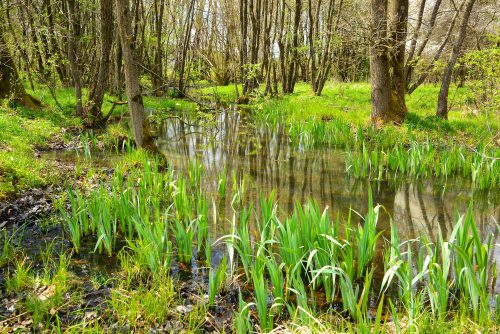
Photo credit: Gregor Domanjko
The streams, wet meadows and forests of the Goričko Nature Park and the Őrség National Park are among the most valuable wetlands in Europe due to their relatively untouched nature. The fens and marsh meadows found here are of community importance, and the alder groves are of special community importance in the European Union. However, the wetlands of the border area are threatened by many factors, among which in our project we mainly deal with drying caused by climate change, the spread of invasive alien species and increasing pollution. Our goal is to put the wetlands in a good ecological state and the species living in them in a favourable conservation situation in the Slovenian-Hungarian border region, thus fulfilling the requirements of the EU Water Framework Directive and the Habitats Directive. We want to achieve this goal by creating a joint action plan and implementing it in pilot areas, as well as by raising the awareness of the public. The peculiarity of our approach is, on the one hand, that it relies on the cooperation of the nature conservation and water sector involved in the management of wetlands, which is also implemented across borders. On the other hand, we plan and implement exemplary interventions in a narrower area, which, as good practice, can later be expanded by the members of the partnership, and can also be transferred to other stakeholders in the program area.
With the joint management strategy of wetlands, we create the basis for coordinated cooperation between the two countries and the two sectors. This is essential for the long-term preservation and sustainable use of wetlands, as they form a cross-border, unified network. Project partners will also benefit from the creation of a joint action plan, as knowledge, experience and innovations about the management of different habitats will be transferred between them. The Slovenian partners will gain knowledge from the Hungarian partners how to properly manage wet meadows and forests of community importance. The Hungarians, on the other hand, will gain knowledge from their Slovenian colleagues how to properly restore sections of streams and rivers to improve the conservation status of wetland wildlife of community importance. The joint action plan also means a knowledge hub for the project partnership. The joint action plan not only helps the partnership with its subsequent activities, but other authorities and municipalities involved in water management can also rely on it when making their decisions. The action plan also identifies the locations where the water quality of the watercourses is not acceptable due to the discharged sewage, so it is necessary to increase the efficiency of the wastewater treatment.
In order to mitigate the negative effects of climate change, we are experimenting with innovative solutions that are suitable for retaining periodically occurring excess water. As part of this, we will prepare a restoration plan for the backwaters of the Ledava/Lendva Stream, and at 9 other locations we will plan nature-based interventions to improve the water balance of bogs and alder groves of community importance, as well as water-retaining bottom thresholds, embankments, and culverts. We will implement our plans in future projects. In the Slovenian section of the Kobiljski potok stream tributaries, we will also create 2 new riverbeds of cca. 300 m in order to improve the ecological condition of the streams. In the new riverbeds, a more natural river dynamic will be established with small islands of gravel and sand, which will significantly improve the habitat for Natura 2000 species of fish and mussels. The beneficial effects of water retention will not only benefit the endangered species of the wetlands, but also the inhabitants of the surrounding areas.
The project brings two new solutions to the program area to stop the spread of invasive alien species. We purchase a tool called RootWave Pro to control Fallopia species, which offers a chemical-free solution to control this aggressively spreading plant genus on waterfronts. We also present the operation of the device to local governments and farmers, who can later use this technology themselves. For the first time in the region, we are planning a bed covering artefact, which can be a long-term solution to stop the spread of the signal crayfish.
In order to raise the public’s awareness, we hold school sessions and carry out an educational campaign about the threats caused by invasive alien species. We are expanding the tool system for sharing knowledge about wetlands with educational trails, exhibitions and a nature experience park. In addition to traditional methods, we also use innovations such as cartoons about wetlands or fairy tales built around them.
Project achievements and materials
In this section you can find useful materials related to the project.
- File 1
- File 2